FY2025 - Senior Year
Research and Development of Lunar Exploration Robots
Research and development of small swarm robots for lunar lava tube exploration. As a joint project with JAXA and AIST, experienced everything from hardware improvements and simulation building to demonstration experiments at the JAXA test facility and cave experiments in Australia.
Chuo University, Dept. of Electrical, Electronic, and Communication Engineering
Researcher (Hardware improvements & simulation environment)
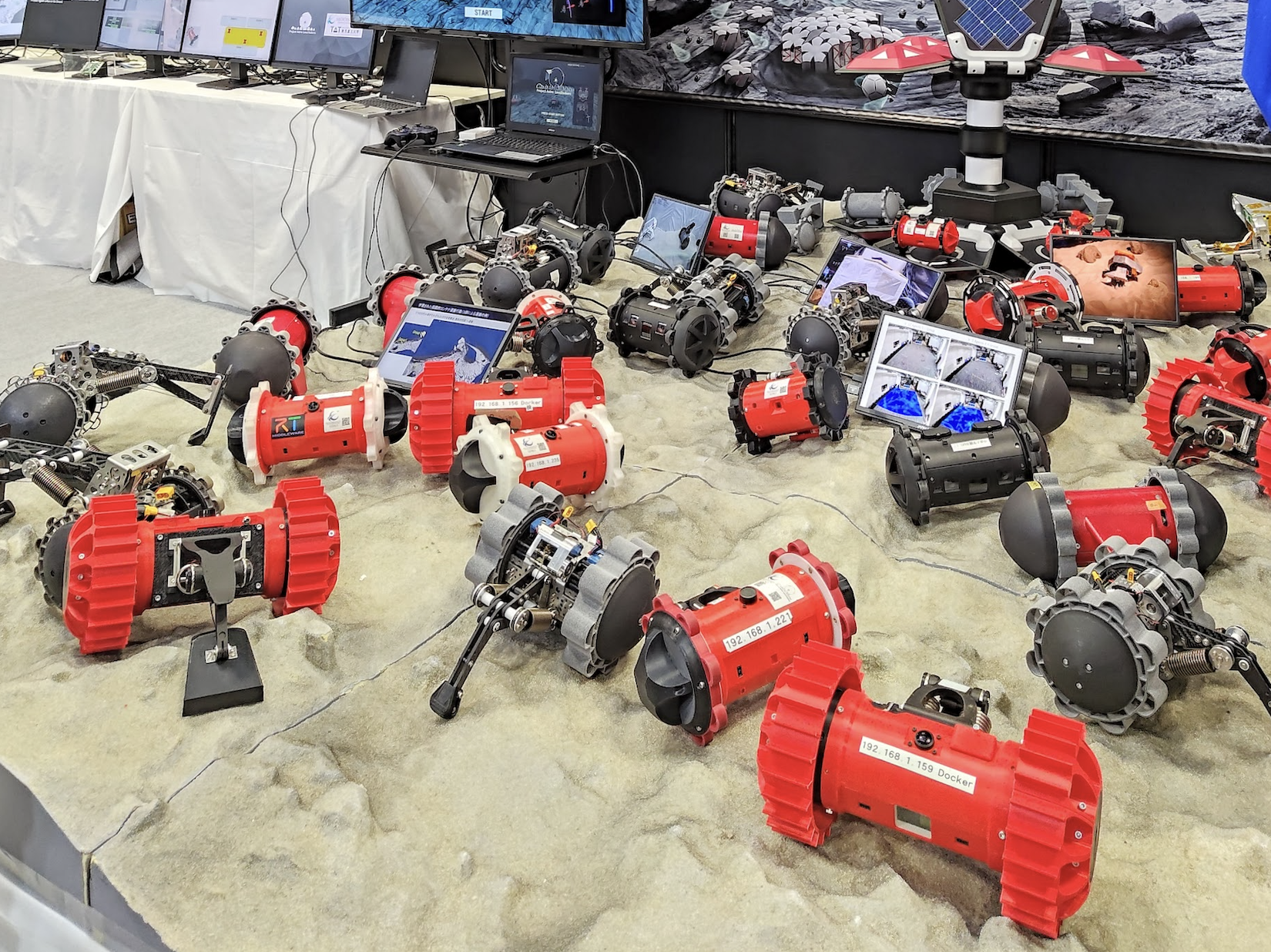
In my senior year, I belonged to the Kunii Laboratory at Chuo University, where I conducted research and development on small swarm robots capable of jumping, aimed at exploring lunar lava tubes. This research was adopted as a Moonshot Research and Development Program, advanced jointly with JAXA, AIST, Tokyo University of Agriculture and Technology, etc.
Small swarm robot "RED" developed in Kunii Lab
Improvements and Experiments
I was mainly in charge of improving the hardware of the robot and building the simulation environment.
Main Responsibilities
- CAD design of the jumping pad
- Prototyping and refinement using 3D printers
- Actual-machine experiments and evaluation via motion capture
- Building the simulation environment in Python
- Developing a motion-capture data analysis tool
- Trajectory analysis and heatmap generation from fixed-camera footage
- Participation in field demonstrations at the JAXA test facility and the Australian cave experiment
For the hardware improvement, for example, there is the design of the robot's jumping pad. I repeated an iterative cycle of CAD design, 3D printing, actual-machine testing, and evaluation using motion capture data — more than 30 prototypes over about two months. I first tried a design with a rotation mechanism to improve turning, but it broke when sand grains jammed it, so I shifted to drawing performance out of a simpler structure rather than a complex mechanism. I ultimately arrived at a shape that balances running, jumping, and turning, and it was adopted across many robots in the laboratory. Also, for the 10-day experiment conducted at the exploration experiment building on the JAXA Sagamihara Campus, we made improvements such as increasing wheel strength and mounting high-torque motors to climb sand dunes several meters high.
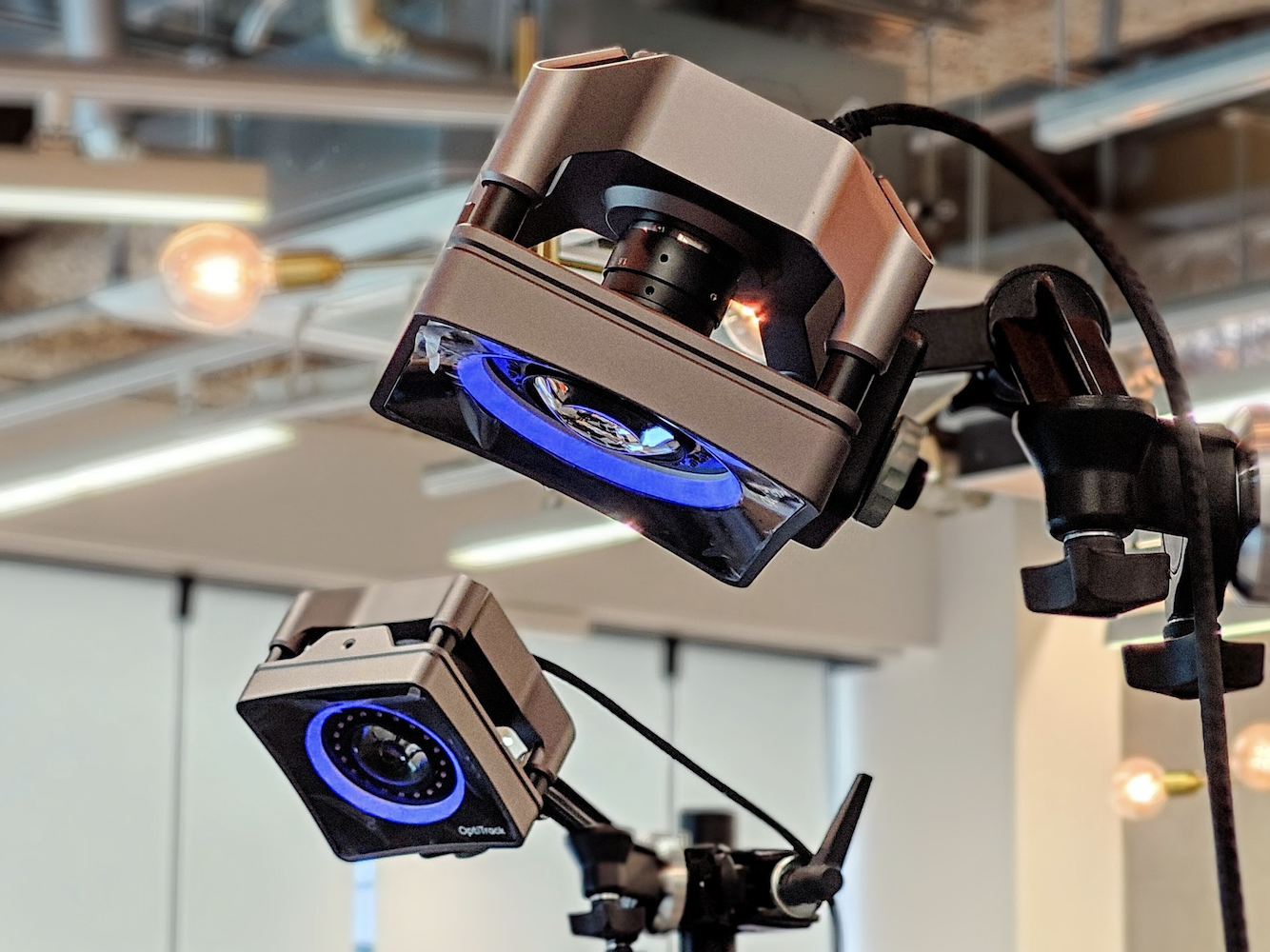
Motion capture used for data collection in experiments
Furthermore, since the analysis of motion capture data in experiments was a challenge due to the time required, I independently developed an application that performs optimal data trimming and automatic analysis just by importing exported data. For more details, please see the Mocap Plus page.
Simulation Environment Construction
Regarding the simulation, I created a program that reproduces the algorithm implemented in the robot in a 2D environment. I ran about 3,500 trials on complex terrain simulating real environments to calculate the number of robots required to achieve the target exploration rate. I also verified inversely estimating the original terrain from the obtained exploration rate; for this inverse estimation I used gradient-boosted decision trees and achieved about 88.6% accuracy.
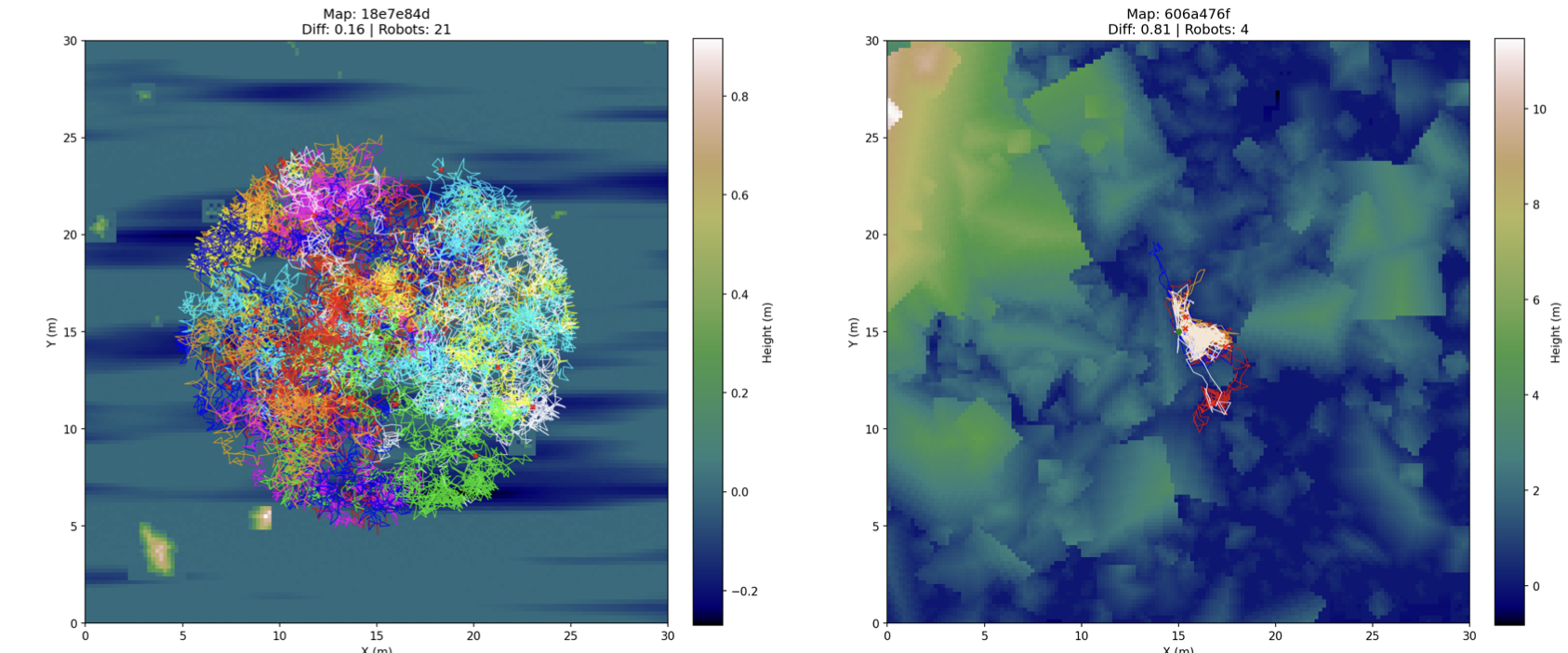
Part of simulation results
Cave Demonstration Experiment in Australia
As part of the project, a demonstration experiment using actual machines was conducted in a cave in Queensland, jointly with the Australian national science agency CSIRO. I participated as one of 5 members selected from the 24 in the laboratory and acquired useful data.
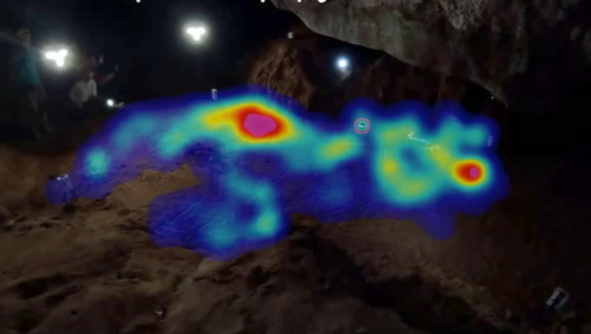
Heatmap analysis I performed from fixed-point video
In a cave environment, precise positioning systems like motion capture cannot be used. Therefore, I contributed to the visualization of experimental data by developing a program that tracks the LED light or body color of the robot from fixed-point camera footage and draws a heatmap of the movement trajectory and exploration status.